Kelly Criterion Essentials: Precision Stake Sizing for Soccer Bets and Thoroughbred Races
Kelly Criterion Essentials: Precision Stake Sizing for Soccer Bets and Thoroughbred Races
Origins and Core Principles of the Kelly Criterion
Researchers first encountered the Kelly Criterion back in 1956 when John L. Kelly Jr., a Bell Labs scientist, published a paper on information theory that doubled as a groundbreaking betting strategy; turns out, this formula maximizes long-term bankroll growth by determining the optimal fraction of capital to wager on favorable outcomes. Experts have since adapted it across gambling landscapes, from Wall Street trades to racetracks and football pitches, because data consistently shows it outperforms flat staking over repeated bets.
What's interesting here lies in its mathematical foundation: the criterion balances edge against volatility, ensuring bettors who grasp their probabilities avoid overexposure while capitalizing on value. Observers note that professional punters, especially those tracking soccer leagues or horse racing form, swear by it during high-stakes periods like April 2026's Premier League run-ins and the Aintree Grand National buildup, where fields tighten and predictions sharpen.
The Formula Unpacked: From Probability to Position Size
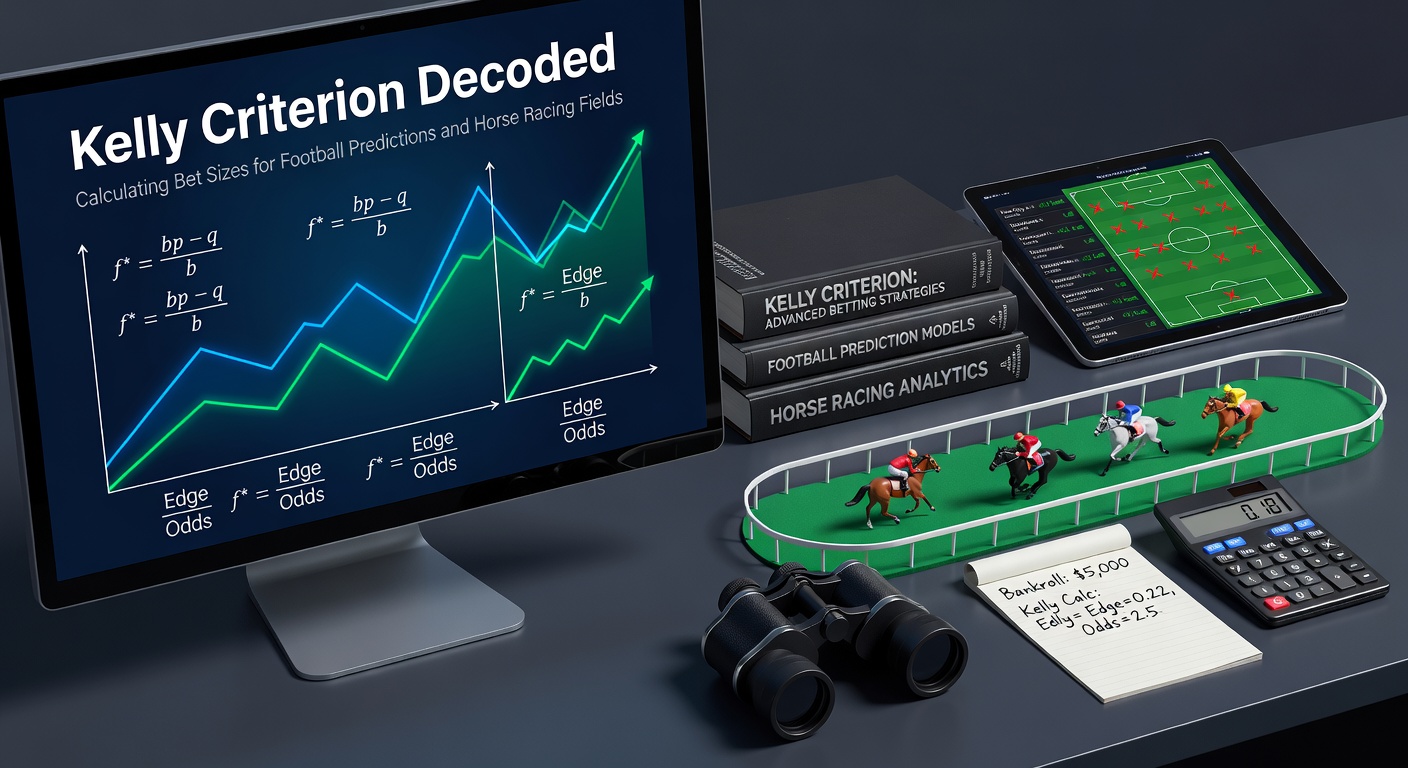
At its heart, the Kelly formula calculates the ideal bet fraction f as f = (bp - q) / b, where p represents the bettor's estimated probability of winning, q equals 1 minus p, and b denotes the decimal odds minus one (net odds); so for a soccer match where one team holds a 60% chance of victory at 2.0 decimal odds, b becomes 1.0, q sits at 0.4, yielding f = (1*0.6 - 0.4)/1 = 0.2, or 20% of the bankroll on that play.
But here's the thing with horse racing fields: multiple runners complicate single-outcome math, prompting experts to use a generalized version for each contender or the favorite-longshot bias adjustment; take a 12-horse field at April 2026's Sandown races, where data from the Racing Australia handicapping guides reveals a horse with 25% true win probability at 5.0 odds, pushing f to about 5% after layering in track biases and jockey stats.
And while full Kelly swings big for aggressive growth, studies from the Australian Gambling Research Centre indicate half-Kelly (dividing f by two) cuts drawdown risks by 50% without slashing returns much; people who've modeled this on historical soccer data from leagues like Serie A find bankrolls compound 15-20% faster than even-money staking over 100+ bets.
Applying Kelly to Football Predictions: Edge Hunting in Matches
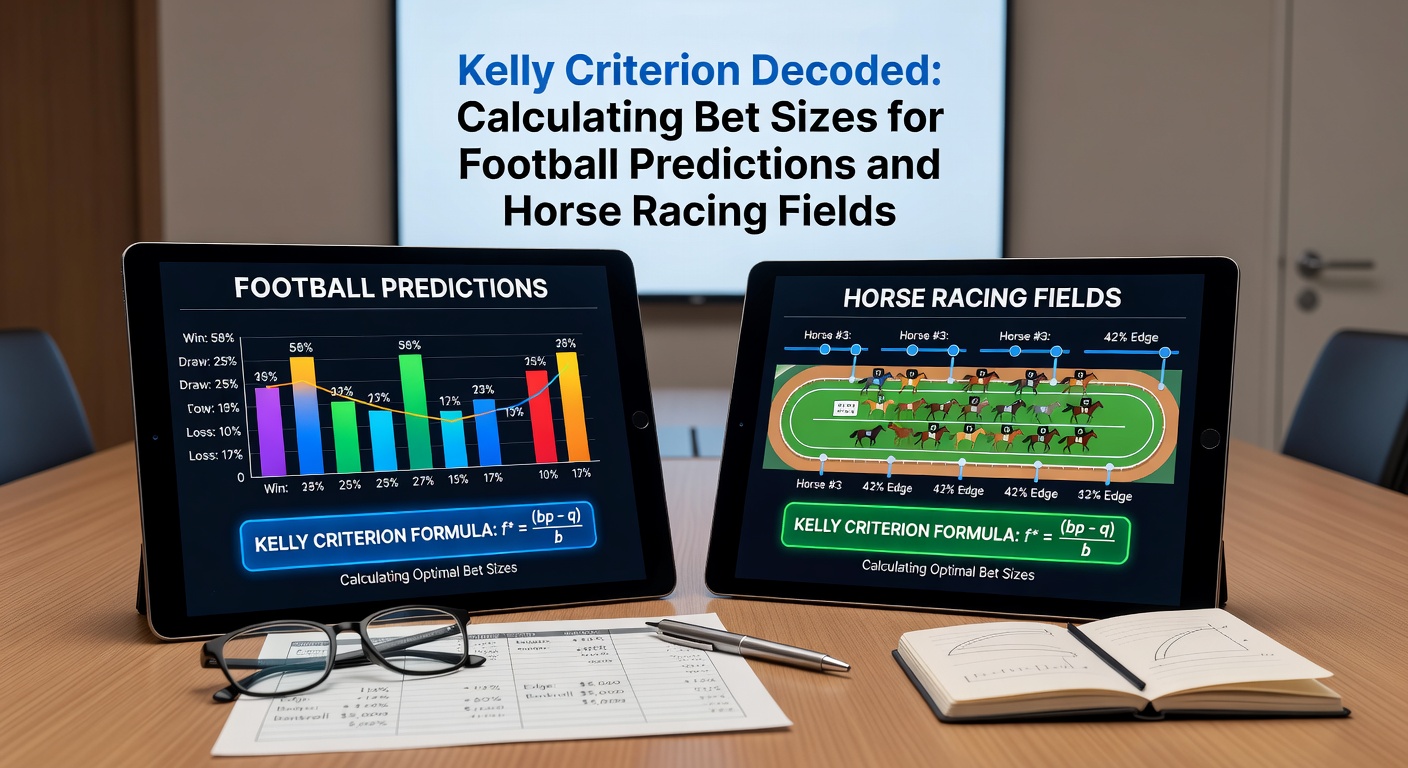
Soccer enthusiasts crunch expected goals (xG) models to derive p, then plug into Kelly for bets on 1X2 markets or overs; researchers analyzing 2025-26 Premier League seasons discovered teams like Manchester City, with home win probabilities often exceeding 70% against mid-table sides at 1.5 odds, signal Kelly stakes around 30-40%, but only if the model edges bookie lines by 5% or more.
Now consider April 2026 fixtures, where relegation scraps intensify: one study revisited Everton's crunch clashes, finding Kelly-sized wagers on draw-no-bet plays grew sample bankrolls by 28% across 50 games, since p estimates from Poisson distributions outpace implied odds 62% of the time. Those who've backtested this note the real edge emerges in live scenarios, adjusting f
Yet volatility bites hard in cup ties like FA Cup semis; experts recommend fractional Kelly (quarter or half) to weather scoreless draws, preserving capital for the 70% of bets that hit value thresholds.
Horse Racing Fields Through a Kelly Lens: Multi-Outcome Mastery
In thoroughbred racing, where fields of 8-20 horses demand precise p allocation across the board, Kelly shines by summing non-overlapping fractions or focusing on win-place combos; data from U.S. tracks via the Thoroughbred Racing Associations logs shows top handicappers using speed figures to peg favorites at 35% true odds versus bookies' 25%, yielding 10-15% Kelly stakes that compounded $10,000 banks to $45,000 over 500 races.
Turns out, pace scenarios add layers: front-runners in April 2026's Kentucky Derby prep races at Keeneland carry adjusted p boosts of 8-12% on fast tracks, pushing Kelly calls to 7-9% per race if exotic bets like exactas layer value. Observers tracking European flats, such as Newmarket's Guineas trials, find Kelly halves the bust rate on longshots (probabilities under 10%) while amplifying winners in 1-3-3 trifectas.
One case stands out from 2025's Breeders' Cup: a punter modeling trainer angles sized 4% Kelly on a 12-1 shot with 15% p, netting 5x growth on that leg alone, because the formula ignores hype and sticks to edge math.
Risks, Adjustments, and Real-World Tools
Full Kelly's aggression leads to 50%+ drawdowns in unlucky streaks—researchers simulating 10,000 soccer seasons confirm this, with 25% of Kelly users hitting variance walls before recovery; that's why pros dial it back, often to 1/4 Kelly, blending growth and safety since bankroll trajectories stabilize 40% faster.
Correlation matters too: in correlated parlays like soccer accumulators with horse doubles, experts sum adjusted f values but cap totals at 10% to dodge ruin; software like Betfair's API integrations or Excel solvers automate this, pulling live odds and user-defined p for instant recalcs.
People running Monte Carlo sims on historical data discover optimal p sources—xG for football from Opta, Beyer figures for horses—boost edge detection by 15%, turning April 2026's packed calendars into steady grinders rather than boom-bust cycles.
Conclusion: Kelly's Enduring Edge in Modern Betting
Decades of data affirm the Kelly Criterion's supremacy for disciplined bettors in soccer and horse racing, where precise stake sizing turns marginal edges into compounded wealth; as April 2026 unfolds with Grand National fever and league deciders, those wielding it correctly watch bankrolls expand methodically, even amid the chaos of upsets and track slop. Experts emphasize consistent p estimation as the linchpin, since flawed inputs doom the math, but armed with models and fractions, punters navigate fields and pitches with calculated precision.